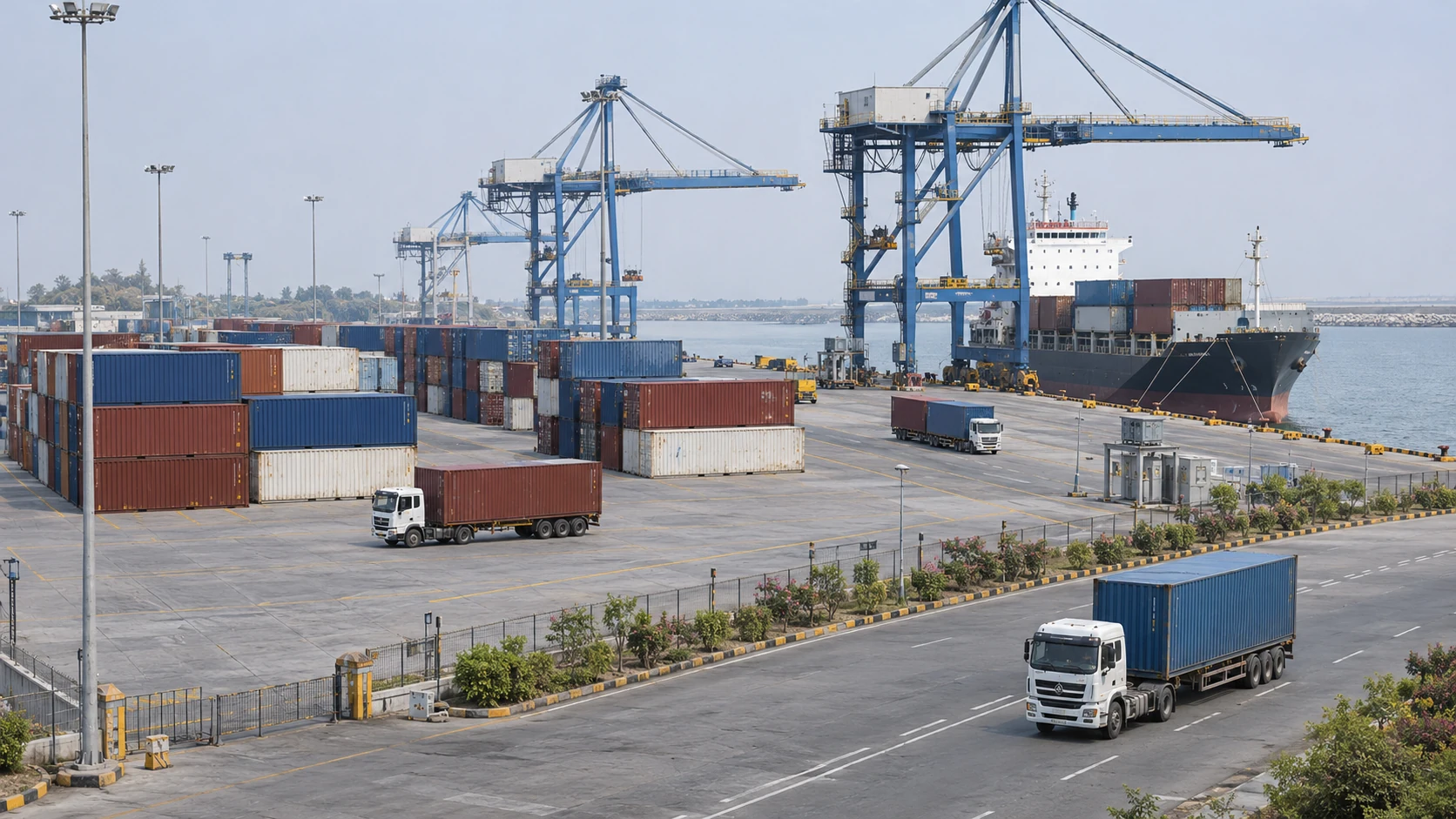
edge. Port flow reviewIllustrative
0130 minApproach
028 minGate
0334 minYard
046 minExit
Start here
Landside Flow & Capacity Intelligence
Examine arrival, queue, gate, yard and handling events together.
Explore the solutionFor port operations, engineering, planning and finance
Examine landside movement, mobile equipment investment and concession performance through one evidence-led approach.
Your decisions
Trace arrivals, gate movements, yard activity and exit events. Compare arrival patterns and operating constraints before testing a change to appointments, staffing or capacity.
Assess the required service level, duty cycles, maintenance and energy dependencies. Compare ownership, leasing, replacement and electrification with their capacity and cost assumptions.
Reconcile throughput and service records with executed concession terms, amendments, minimum guarantees and applicable charges. Show how each amount was calculated.
Relevant solutions
Start here
Examine arrival, queue, gate, yard and handling events together.
Explore the solutionExpansion
Compare equipment, operating and energy options against terminal demand and service requirements.
Explore the solutionStart here
Connect executed agreements and amendments to throughput, obligations and supporting records.
Explore the solutionYour working outputs
Event definitions, turnaround distributions and bottleneck evidence, with operating scenarios that can be evaluated after an intervention.
Capacity and economic comparisons, energy and maintenance dependencies, and the conditions that need confirmation before approval.
Contract references, source records, reproducible calculations and unresolved items for commercial and finance teams.
A first engagement
Select one terminal, gate complex or concession. Bring the relevant terminal and gate exports, operating definitions and signed contract where applicable. Agree a baseline with traffic, engineering or finance, then test a bounded intervention or reporting cycle before considering a wider deployment.
Questions & practicalities
The starting scope uses authorised records from existing systems. It defines the necessary interfaces and produces a specific operational or commercial output. Any production integration is agreed with your technology and operating teams.
Agree consistent arrival and exit boundaries, compare similar operating periods, and examine both typical and high-delay movements. Include external waiting where the data supports it so an intervention is assessed across the complete measured journey.
Yes. The engagement defines each party’s permitted data, responsibilities and review outputs. Shared measures and disputed interpretations are recorded without assuming that all parties can access the same underlying records.
The next conversation
Tell us the decision, the institution and the evidence available. We’ll help define a focused first engagement.
Start a conversationTell us who you are and the decision you are pricing. The first conversation costs nothing. A reply comes on working days.
Or write to [email protected].